The short answer
A pre-employment physical is a medical exam an employer asks you to complete after it has made you a conditional job offer. It checks whether you can safely do the essential duties of the job, with or without a reasonable accommodation.
Under the Americans with Disabilities Act (ADA), employers with 15 or more employees can’t require a medical exam before an offer. After a conditional offer, they can, as long as everyone entering the same job category is examined. That rule comes from the EEOC’s enforcement guidance on pre-employment medical examinations.
A physical is usually one part of a wider pre-hire check. To see what the rest may show, here’s how to run a background check on yourself.
What does a pre-employment physical consist of?
The exam depends on the job. Office roles may need little or nothing; warehouse, health care, transportation and public safety roles usually need more.
| Part of the exam | What it usually covers | Common in |
|---|---|---|
| Health history form | Past conditions, surgeries, current medications | Most physicals |
| Vital signs | Blood pressure, pulse, height and weight | Most physicals |
| Vision and hearing | Eye chart, color vision, hearing test | Driving, safety and health care jobs |
| General exam | Heart, lungs, abdomen, joints and reflexes | Most physicals |
| Physical ability test | Lifting, carrying, bending, climbing or endurance | Warehouse, construction, first responders |
| Respirator clearance | Lung function and fit-testing questionnaire | Health care, industrial jobs |
| Immunizations or TB test | Vaccination records, tuberculosis screening | Health care, schools, child care |
| Drug test | Urine or oral fluid sample | Many employers, often at the same visit |
A drug test is often collected at the same appointment, but under the ADA a test for illegal drug use is not treated as a medical exam. See whether a background check includes a drug test.
Commercial drivers have their own federally required exam. See the federal physical qualification rules, 49 CFR 391.41.
Reasons you could fail a pre-employment physical
“Failing” usually means the examiner reports that you cannot currently perform an essential job function safely, or that a condition needs follow-up. Common reasons include:
- Not meeting a physical requirement of the job, such as a lifting test for a role that requires regularly lifting 50 pounds.
- A safety standard you don’t meet, such as vision or hearing standards for driving or equipment jobs.
- A condition that is not under control, such as very high blood pressure, which may lead to a “deferred” result until you see your own doctor.
- Missing records, such as immunizations or a TB result for a health care job.
- An incomplete or inaccurate health form. Leaving things off can cause more trouble than the condition itself.
- A positive drug test collected at the same visit.
Under the ADA, an employer that withdraws an offer after a medical exam must show the reason is job-related and consistent with business necessity, or that you would pose a direct threat that an accommodation can’t reduce. You can ask about a reasonable accommodation if a condition affects how you would do the job.
Your rights during the exam
- Same exam for everyone. All new hires in the same job category should get the same exam.
- Confidential results. Medical information must be kept in separate, confidential files, not in your general personnel file.
- Accommodation. You can request an accommodation, both for the exam itself and for the job.
- Ask what is being tested. You can ask the clinic or employer which tests are part of the exam.
Some states add their own rules. If you think an offer was withdrawn because of a disability, the EEOC and your state civil rights agency take complaints.
Where you are in the hiring process
A physical request means you are at the conditional offer stage, step four of the hiring process. The employer has said yes, as long as the remaining checks come back clear.
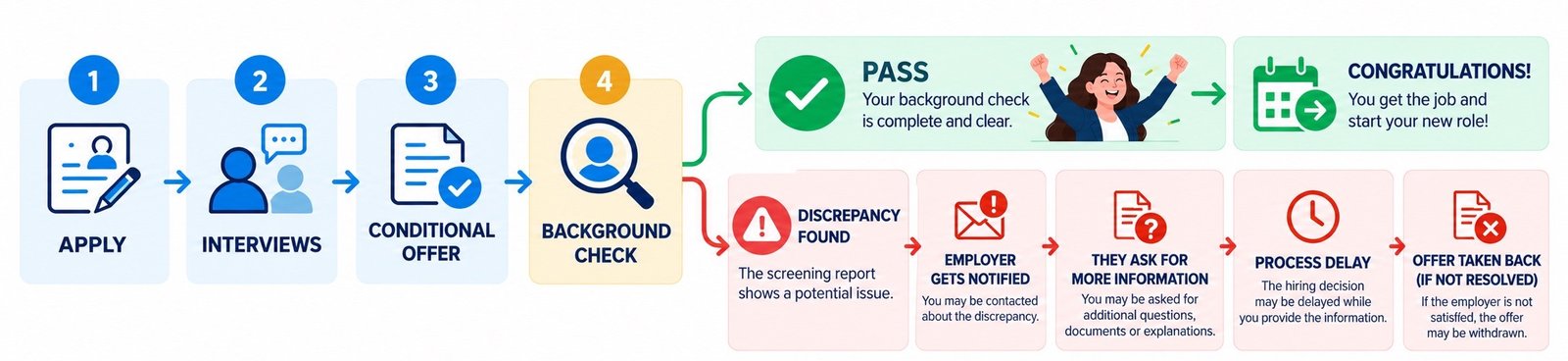
The physical is rarely the only check at this point. Most employers are also running a background check on your criminal records, past employment and education, and sometimes your driving record. See what shows up on an employment background check.
If one of those records is wrong or doesn’t match your application, the check can take the red path in the diagram: a delay, a request for more information and sometimes a withdrawn offer. Those problems usually come from records you could have reviewed in advance, such as a wrong employment date, an unverified degree or a court case without its final outcome.
You may want to see your current records at the official sources, identify any discrepancy and gather the official records that prove what is correct, before the employer’s report comes back. The Self Check Guide shows you how to do exactly that, step by step.
What a pre-employment physical exam includes
A physical exam for a job is usually job-specific. Employers require it to check that candidates can safely perform the essential tasks of the role, especially in physically demanding jobs. Depending on the job, the physical examination may include:
- a medical history review and questions about overall health,
- vital signs such as blood pressure and pulse,
- vision and hearing checks,
- range of motion, lifting or strength tests, and
- sometimes a drug screening, which is a separate test.
These exams are often done by occupational health or occupational medicine clinics. Employers that require a pre-employment physical can generally only do so after a conditional job offer, and only if every candidate in that job has to complete it.
Frequently asked questions
Do you have to undress for a pre-employment physical?
Usually only partly, such as removing outer clothing for a heart, lung or joint exam. Clinics typically provide a gown. You can ask what to expect when you book.
Can an employer give a physical before a job offer?
Not a medical exam, under the ADA. Before an offer, employers can only ask whether you can perform the job duties and can test physical agility in ways that are not medical.
How long does a pre-employment physical take?
Often 30 to 60 minutes. Results that need follow-up, such as a blood pressure recheck, can take longer.
Who pays for a pre-employment physical?
Usually the employer, through an occupational health clinic it chooses. Ask before your appointment.
What jobs require a pre-employment physical?
Commonly commercial driving, warehouse and manufacturing, health care, police and fire, and other physically demanding or safety-sensitive work.
Your next step
Bring your medication list, glasses or hearing aids and any immunization records to the appointment, and ask about an accommodation if you need one.
For the rest of your pre-hire check, get the Signature Edition (Guide + Bonus AI Toolkit) to check your criminal, employment and education records yourself.