The short answer
A 10 panel drug test screens for ten classes of drugs. It covers the five drugs in the standard federal workplace panel, often called the “SAMHSA 5”, plus five drug classes that include common prescription medications. Most 10 panel tests use a urine sample.
If you have been asked to take one for a job, you are usually at the background check stage of hiring, after a conditional offer. The drug test is one part of that stage. Your employer is typically also checking your records at the same time.
A drug test is usually one part of a wider background check. To see what the rest may show, here’s how to run a background check on yourself.
What does a 10 panel drug test test for?
| Drug class | Examples | Also in a 5 panel test? |
|---|---|---|
| Marijuana (THC) | Cannabis | Yes |
| Cocaine | Cocaine, crack | Yes |
| Amphetamines | Amphetamine, methamphetamine | Yes |
| Opiates | Codeine, morphine, heroin | Yes |
| Phencyclidine (PCP) | PCP | Yes |
| Benzodiazepines | Some anxiety and sleep medications | No |
| Barbiturates | Some sedatives and seizure medications | No |
| Methadone | Methadone | No |
| Methaqualone | Quaaludes | No |
| Propoxyphene | A pain medication withdrawn in the US | No |
The first five are the drugs in the 1988 federal workplace testing guidelines, the “SAMHSA 5” described by Thermo Fisher’s SAMHSA overview. Labs and employers can customize panels, so your test may differ. A standard 10 panel test does not include alcohol unless it is added separately.
10 panel vs. 5 panel drug test
A 5 panel test is the most common workplace test and the federal standard for regulated testing. A 10 panel test adds the five classes above, which mostly cover prescription medications. Employers in health care, government and other safety-sensitive work are more likely to use the expanded panel. The lab method is the same; the 10 panel test simply looks for more substances.
For a test with one fewer class, see the 9 panel drug test. For the codes printed on your cup, see drug test abbreviations.
How results work
Most workplace tests follow two steps:
- Screening test. The sample is screened against set cutoff levels. A result below the cutoff is reported as negative.
- Confirmation test. A sample that screens non-negative is retested with a more precise lab method before it is treated as positive.
Negative results often come back within a few business days. Non-negative results take longer because of confirmation and review.
In many programs, a doctor called a Medical Review Officer (MRO) reviews non-negative results before the employer sees them. In federally regulated (DOT) testing, the MRO must give you a chance to explain the result, for example with a valid prescription, under 49 CFR Part 40. Many non-DOT employers use the same process.
What if you take a prescription medication?
Benzodiazepines, barbiturates and some opiates can come from legitimate prescriptions. Do not hide them. If the MRO or testing provider contacts you, provide your prescription details when asked. A verified prescription is usually reported to the employer as a negative result rather than a positive one.
What if you think the result is wrong?
Ask the testing provider or MRO for the result details and how to request a review. In DOT-regulated testing you can ask for your split specimen to be tested at a different lab, generally within 72 hours of the MRO telling you about the result. If the result was reported to your employer as part of a background check from a screening company, you may also have dispute rights under the Fair Credit Reporting Act. See how to question a pre-employment drug test result.
Where you are in the hiring process
A drug test request usually means you are at step four of the hiring process: the background check, after a conditional offer.
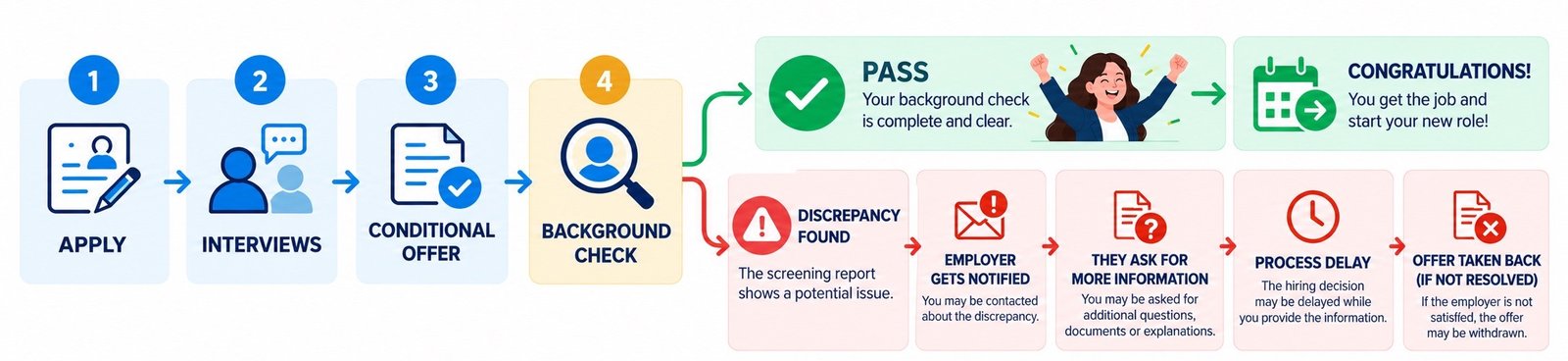
At this stage the employer is usually checking more than the drug test. A typical screening also looks at criminal records, past employment, education and sometimes your driving record. See what shows up on a background check and whether a background check includes a drug test.
If any of those records is wrong, outdated or doesn’t match your application, the check can take the red path in the diagram: the employer is notified, asks you for more information and delays the decision, and the offer may be withdrawn if it isn’t resolved. Most of those problems come from records you could have checked ahead of time, such as a wrong employment date, an unverified degree or a court case with a missing outcome.
You may want to see your current records at the official sources, identify any discrepancy and gather the official records that prove what is correct, before the employer’s report comes back. The Self Check Guide shows you how to do exactly that, step by step.
How a 10 panel lab test works
A 10 panel drug test usually starts with a quick screening test on a urine sample. If the screen is negative, the test results are reported as negative. If the screen is non-negative for one of the panels, such as phencyclidine (PCP) or benzodiazepines, the sample goes for a confirmation lab test using a more precise method before anything is treated as positive. Many programs then send confirmed results to a Medical Review Officer, who checks for prescriptions before the employer is told.
Frequently asked questions
Is a 10 panel drug test urine or blood?
Usually urine. Some providers offer 10 panel tests using oral fluid (mouth swab) or hair samples, but urine is the most common for employment.
Does a 10 panel drug test test for alcohol?
Not by default. Alcohol testing is a separate test that an employer can add. See does alcohol show up on a drug test.
Does a 10 panel drug test test for fentanyl or oxycodone?
Not in the standard ten classes. Many panels can add them, so ask the employer or testing provider which substances your test includes.
Will a failed drug test show up on a background check?
It depends on how the test was ordered and reported. A result is usually shared with the employer that requested it. It is not a criminal record. See whether a background check includes a drug test for how the two are connected.
Your next step
Follow the testing instructions you were given, keep a list of your current prescriptions ready, and use this time to check the other records your employer is reviewing.
Get the Signature Edition (Guide + Bonus AI Toolkit) to check your criminal, driving and employment records yourself. Applying for a driving job? Add the Driving Jobs Pack at checkout: your driving record in any state, the PSP report, the FMCSA Clearinghouse, your DAC report and the CDL 10-year history.