The short answer
If you fail a pre-employment drug test, the employer usually withdraws the job offer. But a “failed” result often goes through several steps first, and some of them give you a chance to explain or challenge it:
- The lab confirms the screening result with a more precise test.
- A Medical Review Officer (MRO), if the program uses one, contacts you about legitimate explanations such as a prescription.
- The verified result goes to the employer, which decides under its policy and the law.
Whether you can still be hired depends on the employer, your state and whether the job is DOT-regulated.
Most drug tests come with a background check too. To see what that part may show, you can run a background check on yourself.
What happens step by step
| Step | What happens | What you can do |
|---|---|---|
| Screen is non-negative | The sample goes to confirmation testing | Nothing yet; this isn’t a final result |
| Lab confirms | A precise test confirms the substance | Wait for the MRO to contact you |
| MRO interview | The MRO asks about prescriptions or medical explanations | Answer, and provide your prescription details |
| Verified positive | The MRO reports the result to the employer | Ask about retesting or a split specimen |
| Employer decision | The employer applies its policy | Ask whether you can reapply, and when |
Can you still be hired after failing a drug test?
Sometimes:
- A valid prescription explained to the MRO is usually reported to the employer as negative.
- State cannabis laws in some states limit how employers can use marijuana results for most jobs, such as California and New York.
- Employer policy. Some employers allow a retest or let you reapply after a waiting period, often six months to a year. Ask HR what its policy is.
- A dilute or invalid sample often leads to a new test rather than a failure. See drug test results explained.
What’s different for DOT jobs
For CDL drivers and other DOT-regulated jobs, a verified positive or a refusal has federal consequences:
- You can’t perform safety-sensitive work for any DOT employer until you complete the return-to-duty process.
- That process requires an evaluation by a Substance Abuse Professional (SAP), any recommended education or treatment, a directly observed return-to-duty test and follow-up testing.
- For truck and bus drivers, the violation is reported to the FMCSA Drug and Alcohol Clearinghouse.
See DOT drug tests for CDL drivers.
If you think the result is wrong
- Ask the MRO about retesting the original sample, or for DOT tests, testing the split specimen. You generally must ask within 72 hours of the MRO telling you about a DOT result.
- Check whether the result came through a background check company. If so, you may get a pre-adverse action notice and can dispute it. See the pre-adverse action notice.
See how to dispute a false positive drug test.
Does a failed drug test show up on a background check?
A drug test result isn’t a criminal record. It’s reported to the employer that ordered it. For DOT-regulated drivers, violations go to the Clearinghouse, which future DOT employers must check. Otherwise, a future employer generally won’t see a past failed test unless it’s reported through a screening company it uses. See does a background check include a drug test.
Where you are in the hiring process
A drug test result usually comes during the background check stage, after a conditional offer.
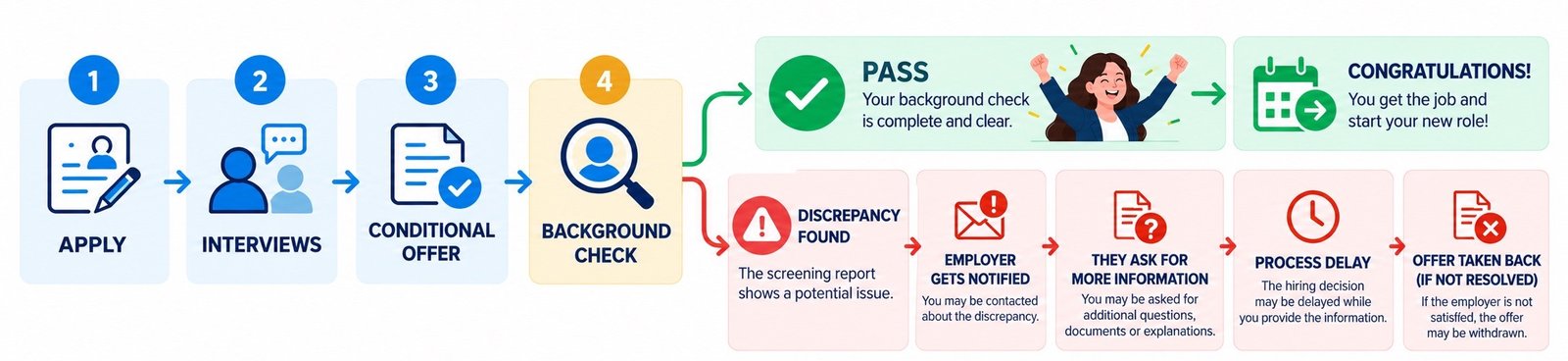
The rest of your background check, covering criminal records, past jobs and education, is still under review. If you reapply later or apply elsewhere, a clean record check helps.
You may want to see your current records at the official sources, identify any discrepancy and gather the official records that prove what is correct, before the employer’s report comes back. The Self Check Guide shows you how to do exactly that, step by step.
State law, federal law and prescribed medications
What happens after a drug screen comes back positive depends on the employer’s policy, state law and, for some jobs, federal law. A few things that can change the outcome:
- Prescribed medications. If you test positive for a drug you take legally, tell the MRO and give your prescription details. A legitimate prescription is usually reported to the employer as a negative result.
- State law. Some states protect job applicants who use cannabis off duty, or require employers to offer a retest. Others don’t.
- Federal law. DOT-regulated jobs follow federal rules, and a positive result there also requires a return-to-duty process, often through a rehabilitation program, before you can do safety-sensitive work.
- Testing method. Ask which test was used and whether it was confirmed by a lab.
Frequently asked questions
Will I be told if I failed my drug test?
Usually. The MRO contacts you before reporting a positive result. The employer then informs you of its decision.
Can I reapply after failing a drug test?
Often, yes, after the employer’s waiting period. Ask HR for its policy.
Does a failed pre-employment drug test affect other jobs?
For non-DOT jobs, generally not directly. For DOT jobs, yes: you must complete return to duty before driving for any DOT employer.
What if I take prescription medication?
Tell the MRO and give them your prescription details. A valid prescription is usually reported to the employer as negative.
More drug and health test guides: Labcorp and Quest drug tests, drug test results explained, TB tests for employment and pre-employment physicals.
Your next step
Answer the Medical Review Officer’s call, ask about retesting if you believe the result is wrong, and ask the employer about its reapplication policy.
Get the Signature Edition (Guide + Bonus AI Toolkit) to check your criminal, driving and employment records yourself.
Applying for a driving job? Add the Driving Jobs Pack at checkout: your driving record in any state, the PSP report, the FMCSA Clearinghouse, your DAC report and the CDL 10-year history.