The short answer
A TB test for employment checks whether you have been infected with the bacteria that cause tuberculosis. Health care employers are the most common to require one, along with schools, child care centers, nursing homes, correctional facilities and some other workplaces, often because of state rules.
The CDC recommends that all US health care personnel be screened for TB when they are hired. That screening includes a risk assessment, a symptom check and a TB blood test or skin test.
A TB test is often one part of a wider check. To see what the rest may show, here’s how to run a background check on yourself.
The two types of TB test
| Feature | TB skin test (TST) | TB blood test (IGRA) |
|---|---|---|
| How it’s done | A small injection under the skin of the forearm | A blood draw |
| Visits needed | Two: one to place the test, one 48 to 72 hours later to read it | Usually one |
| Two-step testing | Often required for health care workers’ first test | Not needed |
| After BCG vaccine | Can give a false positive | Preferred for people who had the BCG vaccine |
| Results | Read as a measurement of the skin reaction | Lab result, often in a few days |
What is a two-step TB test?
If a health care employer uses the skin test for your baseline, the CDC recommends two-step testing. If the first test is negative, a second skin test is given 1 to 3 weeks later. This helps catch a reaction that has faded over time, so a later positive isn’t mistaken for a new infection.
If you had a documented negative skin test within the past 12 months, the CDC says a single new test can count as the second step. A blood test doesn’t need two steps.
How long is a TB test good for employment?
There’s no single national rule. It depends on the employer, the type of job and your state. Many employers accept a negative result from within the past 12 months, while some require one from within the last 90 days or a test done after your offer. Ask the employer exactly what date range and paperwork it accepts.
The CDC no longer recommends routine yearly TB testing for most health care workers unless there’s a known exposure or ongoing transmission, but some employers and states still require annual testing or a yearly symptom questionnaire.
What happens if your TB test is positive?
A positive test doesn’t automatically mean you can’t be hired.
- Follow-up. You’ll usually need a chest X-ray and a symptom check to rule out active TB disease.
- Latent TB infection. Many people with a positive test have latent TB, which isn’t contagious and causes no symptoms. Treatment is encouraged. Most employers can clear you to work once active TB is ruled out.
- Active TB disease. This needs treatment, and you would usually need medical clearance before working.
- Previous positive. If you’ve tested positive before, you usually shouldn’t be retested. Bring your records and the employer will typically do a symptom screen and may ask for a recent chest X-ray.
Medical information from a TB test is confidential and should be kept separate from your general personnel file.
Where you are in the hiring process
A TB test is usually part of your onboarding after a conditional offer, alongside other checks.
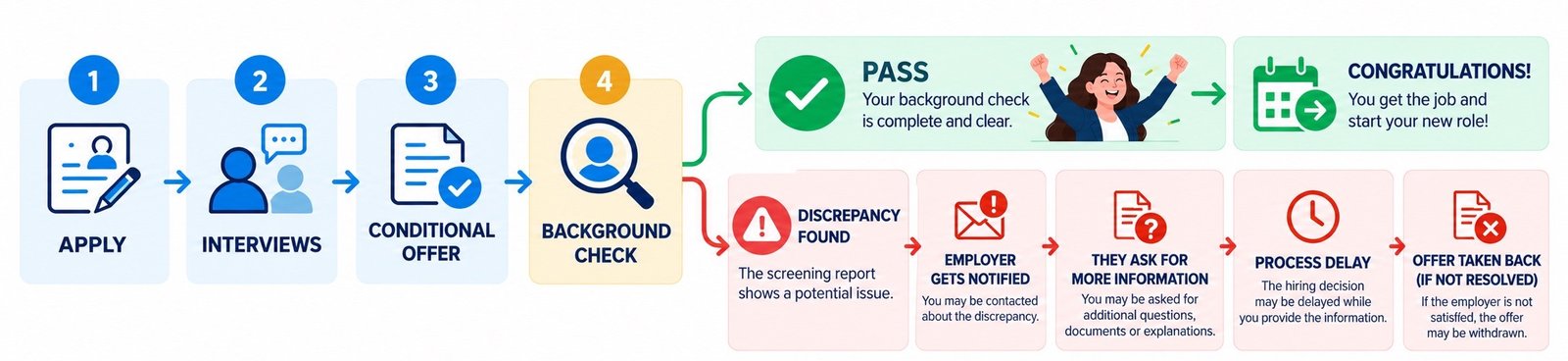
Health care and school employers usually run a fuller background check at the same time: criminal records, fingerprints, license verification, exclusion lists and employment and education history. See the OIG exclusion list, professional license verification and pre-employment physicals.
If something in those records is wrong, the hire can take the red path in the diagram: a delay, a request for more information or a withdrawn offer. These problems are often avoidable with a check of your own records first.
You may want to see your current records at the official sources, identify any discrepancy and gather the official records that prove what is correct, before the employer’s report comes back. The Self Check Guide shows you how to do exactly that, step by step.
TB skin tests vs. blood tests
There are two main types of tuberculosis test for employment:
- TB skin tests (also called the Mantoux or PPD test) inject a small amount of purified protein derivative under the skin. You return in 48 to 72 hours to have it read.
- TB blood tests (such as QuantiFERON-TB Gold) need one blood draw and no return visit. They’re often preferred if you had the BCG vaccine, because the vaccine can cause a false positive on a skin test.
If either test is positive, you’ll usually need a chest X-ray to check for active disease. Occupational health clinics, urgent care centers and some pharmacies offer TB test services for employment.
Frequently asked questions
Where can I get a TB test for employment?
Your doctor, an urgent care or occupational health clinic, a pharmacy that offers TB testing, or your local health department. Many employers send you to a specific clinic and pay for it.
Who pays for a TB test for a job?
Often the employer, especially when it sends you to its own clinic. Ask before you pay for one yourself.
Can I work while waiting for my TB test results?
It depends on the employer. Some let you start non-patient duties after a negative symptom screen and the first test; others wait for all results.
Do I need a TB test if I had the BCG vaccine?
Usually yes. A blood test is preferred because the vaccine can cause a false positive on the skin test.
Your next step
Ask the employer which TB test it accepts and how recent the result must be, bring any previous TB records to your appointment, and check the rest of your background check records while you wait.
Get the Signature Edition (Guide + Bonus AI Toolkit) to check your criminal, employment and education records yourself. Working with children? Add the Child-Facing Jobs Pack at checkout: child abuse clearances, FBI fingerprints and sex offender checks, state by state, with a clearance tracker.