The short answer
A mouth swab drug test, also called an oral fluid or saliva test, collects a sample from inside your mouth with a small absorbent pad. It looks for the same kinds of drugs as a urine test, such as marijuana, cocaine, amphetamines, opioids and PCP, but it mainly detects recent use: usually within the last day or two.
Employers like it because the collection is quick and is watched by the collector, so there is no private bathroom step. Many use it for pre-employment, post-accident and reasonable-suspicion tests.
Most drug tests come with a background check too. To see what that part may show, you can run a background check on yourself.
How a mouth swab drug test works
- Check-in. You show ID and the collector confirms the test the employer ordered.
- Wait period. The collector usually asks you not to eat, drink, smoke or put anything in your mouth for about 10 minutes before collection.
- Collection. You place the swab between your cheek and gum or under your tongue, often for a few minutes, until an indicator shows the sample is complete. The collector watches the whole time.
- Sealing. The sample is sealed in front of you and labeled with your information on a chain-of-custody form.
- Testing. Some tests give an instant screen on site. Anything that is not clearly negative is sent to a laboratory for confirmation.
How long does a mouth swab test look back?
| Drug class | Typical detection window in oral fluid |
|---|---|
| Marijuana (THC) | Hours up to about 1 to 2 days for most users; longer with heavy use |
| Cocaine | About 1 to 2 days |
| Amphetamines and methamphetamine | About 1 to 3 days |
| Opioids | About 1 to 2 days |
| PCP | About 1 to 2 days |
These are general ranges. Actual windows depend on the amount, how often you use a substance, your body and the lab’s cutoff levels. Oral fluid has a shorter window than urine, which can often detect use for several days, and much shorter than hair, which can look back about 90 days.
Does DOT allow mouth swab drug tests?
DOT added oral fluid as an allowed method in 2023, but it can’t be used yet. The rule requires at least two laboratories certified by the Department of Health and Human Services (HHS) for oral fluid testing. A May 2026 DOT rule published in the Federal Register confirmed that no laboratory was certified, and industry reports in October 2026 said that was still the case.
So for now, DOT-regulated jobs such as truck and bus drivers, pilots and rail crews still use urine tests. Non-DOT employers can and often do use oral fluid tests, subject to state law.
How results are reviewed
- Screening. The sample is checked against cutoff levels. Below the cutoff is reported negative.
- Lab confirmation. A non-negative screen is confirmed in a laboratory with a more precise method.
- Medical review. In many programs, a Medical Review Officer (MRO) reviews confirmed positives and contacts you before the employer is told, so you can explain a valid prescription.
If you think a result is wrong, ask about having the sample retested. See how to question a pre-employment drug test result and how long drug test results take.
Where you are in the hiring process
A swab test usually happens at step four of the hiring process, after a conditional offer, while the background check is in progress.
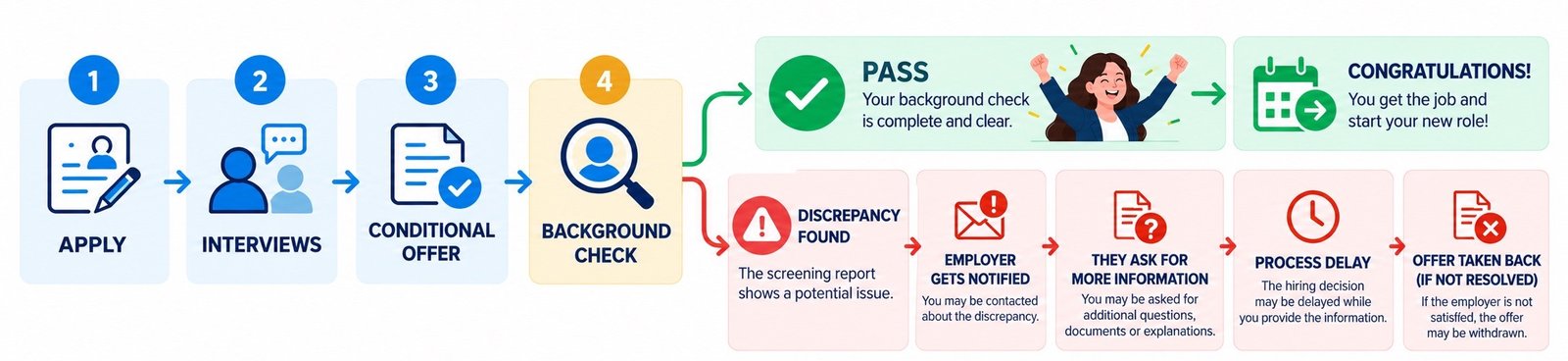
The swab takes minutes, but the background check that runs alongside it covers much more: criminal records, past employers, education and, for driving jobs, your driving record. See what shows up on an employment background check.
If something in those records is wrong or doesn’t match your application, the hire can take the red path in the diagram: the employer reviews the issue, asks you for more information and may delay or withdraw the offer. Most of those issues come from records you could have reviewed beforehand, such as a wrong job date, a degree that can’t be verified or a court case missing its final outcome.
You may want to see your current records at the official sources, identify any discrepancy and gather the official records that prove what is correct, before the employer’s report comes back. The Self Check Guide shows you how to do exactly that, step by step.
How oral fluid drug testing works
In a saliva drug test, you or a collector place a swab in your mouth until it collects enough fluid, often under observation. Sample collection is quick and hard to tamper with. The swab is then tested for drugs or their drug metabolites, either with an instant device or at a lab.
Oral fluid drug testing mainly detects recent use, often within a day or two, so its detection window is shorter than urine or hair. Positive results from instant tests should be confirmed at a lab to get accurate results. Employers choose the test type based on what they want to detect and their state’s rules.
Frequently asked questions
Is a mouth swab test more accurate than a urine test?
Both are accepted, lab-confirmed methods. They measure different time windows: oral fluid is better at showing recent use, while urine covers a longer period.
Can a mouth swab test detect alcohol?
Some oral fluid tests can detect alcohol, but only if the employer orders it. A standard drug panel doesn’t include alcohol. See does alcohol show up on a drug test.
What panels are used for mouth swab tests?
Common options are 5, 6, 10 and 12 panel tests. Ask the employer or testing provider which substances your test includes. See the 10 panel drug test.
Can CBD affect a mouth swab test?
A test that includes marijuana looks for THC, not CBD. A CBD product that contains THC could affect the result. See does CBD show up on a drug test.
Your next step
Ask which panel and sample type your test uses, have your prescription list ready for the Medical Review Officer, and use the time to check the other records your employer is reviewing.
Get the Signature Edition (Guide + Bonus AI Toolkit) to check your criminal, driving and employment records yourself.
Applying for a driving job? Add the Driving Jobs Pack at checkout: your driving record in any state, the PSP report, the FMCSA Clearinghouse, your DAC report and the CDL 10-year history.